
by
Garrett Clark

Retirement Planning
Can You Rollover Both Spouses’ Retirement Funds Into the Same Solo 401(k)?
Married business owners can unlock powerful tax and retirement strategies using a Solo 401(k), but understanding how spousal accounts work is key. This guide breaks down how both spouses can roll over retirement funds into one plan while maintaining compliance, maximizing contributions, and building long-term wealth together.

Search
Search
Category

Any Question?
Let’s talk
Any Question?
Let’s talk
Search
Search
Category
Any Question?
Let’s talk
For married business owners, one of the most common questions is whether both spouses can combine their retirement funds into a single Solo 401(k) plan.
If you and your spouse both work in the business, contribute to the same plan, and have existing retirement accounts, it is natural to wonder if everything can be consolidated into one place. Many couples want simplicity, but also want to make sure they are staying compliant.
The short answer is yes, but with an important distinction.
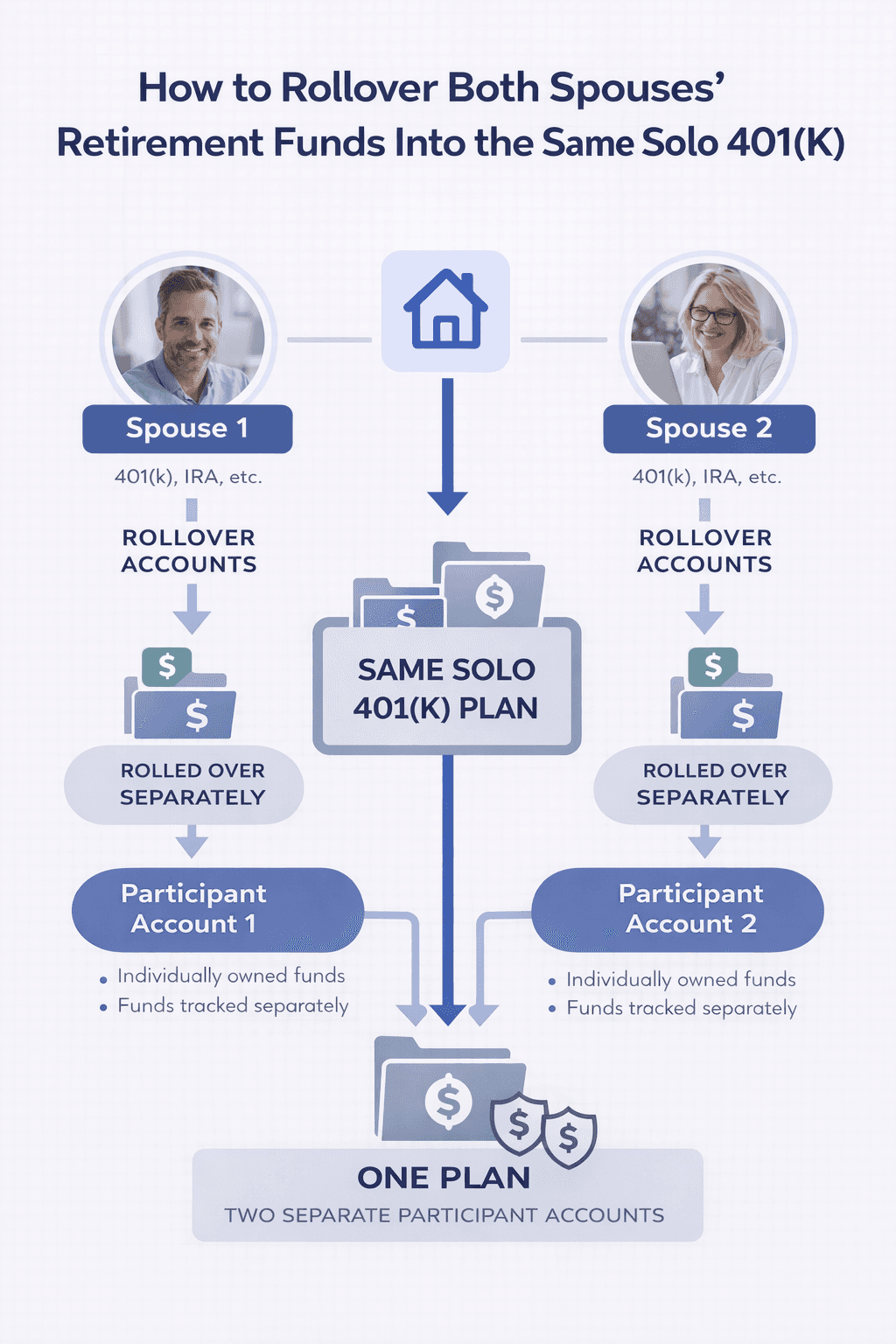
You can roll both spouses’ eligible retirement funds into the same Solo 401(k) plan. However, each spouse must maintain their own separate participant account within that plan.
How a Solo 401(k) Works for Married Business Owners
A Solo 401(k) that covers a married couple is still considered one retirement plan under one employer. This means there is one plan document, one EIN tied to the business, and one overall plan structure.
Even though it is one plan, each spouse is treated as their own participant within that structure. This distinction is what keeps the plan compliant while still allowing both spouses to benefit from it.
A helpful way to think about it is as one umbrella plan with two separate accounts underneath. Each spouse has their own balance, contribution limits, and reporting, even though everything operates under the same plan.
Why Separate Participant Accounts Are Required
Keeping accounts separate is not optional. It is a requirement for compliance.
Each participant in a Solo 401(k) must be tracked individually because contribution limits apply per person, not per plan. Required minimum distributions are calculated separately for each individual, and any loan provisions are based on each person’s account balance.
In addition, tax reporting must be done individually. Forms such as the 1099-R are issued per participant, not per household.
If funds were combined into one account, it would create significant reporting issues and could lead to compliance problems with the IRS. Maintaining separation ensures accuracy, clarity, and proper administration of the plan.
What Can Be Rolled Into a Solo 401(k)?
Each spouse can roll over their own eligible retirement funds into their respective participant account within the same plan.
Common eligible rollovers include funds from former employer 401(k) plans, 403(b) or 457 plans, traditional IRAs in most cases, and other qualified retirement accounts.
When completing a rollover, the funds must be directed into the correct participant account. Ownership remains with each spouse, and the funds do not merge or combine at any point.
Roth and pre-tax funds must also be handled properly. If Roth funds are rolled into the plan, they must be placed into a Roth subaccount under that specific spouse’s participant account. Keeping these distinctions clear is essential for both compliance and future tax treatment.

“One plan can simplify your strategy, but separate accounts are what keep it powerful, protected, and compliant.”
Garrett Clark
Director of Sales
Strategic Benefits of One Plan With Two Accounts
While the accounts remain separate, having both spouses under one Solo 401(k) plan creates several meaningful advantages.
One of the primary benefits is simplified administration. Instead of managing two completely separate retirement plans, you only have one plan document, one provider, and one structure to maintain. This reduces complexity while still meeting all compliance requirements.
Another advantage is the ability to coordinate investment strategy. Even though the accounts are separate, both spouses can align their investments under a shared strategy. This allows for better household-level asset allocation, diversification, and long-term planning.
There is also a significant increase in contribution potential. Since each spouse can contribute individually, the total amount that can be contributed as a household is much higher. This creates opportunities to reduce taxable income more aggressively and accelerate retirement savings during high-income years.
If the plan includes a loan feature, each spouse may also have access to their own loan provisions. Loan limits are based on individual balances, which means each person maintains control over their own capital without affecting the others.
Finally, maintaining separate accounts provides clarity for ownership and estate planning. Retirement accounts are individually owned assets, even within a marriage. Keeping them separate supports proper beneficiary designations and simplifies long-term planning.
Common Mistakes to Avoid
Many business owners misunderstand how this structure works, which can lead to avoidable mistakes.
One common mistake is trying to combine both spouses’ funds into one account. Another is failing to properly separate Roth and traditional funds. Some also miscalculate contribution limits by treating them as a household total instead of per individual.
Ignoring individual reporting requirements is another issue that can create complications down the line.
Avoiding these mistakes helps ensure the plan remains compliant and functions as intended.
The Bottom Line
Yes, both you and your spouse can roll your retirement funds into the same Solo 401(k) plan if you both qualify as participants in the business.
However, the funds must remain in separate participant accounts within that plan.
In simple terms, it is one employer plan with two separate participant accounts. Each account is individually owned, tracked, and reported, while still operating under one streamlined structure.
Why This Matters for Business Owners
For married entrepreneurs, this setup offers a balance of simplicity and flexibility. It allows both spouses to participate in one coordinated system while maintaining the legal separation required by retirement plan rules.
When structured correctly, this approach supports tax efficiency, investment coordination, and long-term wealth building. It allows business owners to focus less on administrative complexity and more on growing both their business and their financial future.
Final Thought
Most people focus on where their money goes.
Smart business owners focus on how it is structured.
That structure determines how much you keep, how efficiently it grows, and how well it is protected over time.
This content is for educational purposes only and should not be considered legal, tax, or investment advice.
For married business owners, one of the most common questions is whether both spouses can combine their retirement funds into a single Solo 401(k) plan.
If you and your spouse both work in the business, contribute to the same plan, and have existing retirement accounts, it is natural to wonder if everything can be consolidated into one place. Many couples want simplicity, but also want to make sure they are staying compliant.
The short answer is yes, but with an important distinction.
You can roll both spouses’ eligible retirement funds into the same Solo 401(k) plan. However, each spouse must maintain their own separate participant account within that plan.
How a Solo 401(k) Works for Married Business Owners
A Solo 401(k) that covers a married couple is still considered one retirement plan under one employer. This means there is one plan document, one EIN tied to the business, and one overall plan structure.
Even though it is one plan, each spouse is treated as their own participant within that structure. This distinction is what keeps the plan compliant while still allowing both spouses to benefit from it.
A helpful way to think about it is as one umbrella plan with two separate accounts underneath. Each spouse has their own balance, contribution limits, and reporting, even though everything operates under the same plan.
Why Separate Participant Accounts Are Required
Keeping accounts separate is not optional. It is a requirement for compliance.
Each participant in a Solo 401(k) must be tracked individually because contribution limits apply per person, not per plan. Required minimum distributions are calculated separately for each individual, and any loan provisions are based on each person’s account balance.
In addition, tax reporting must be done individually. Forms such as the 1099-R are issued per participant, not per household.
If funds were combined into one account, it would create significant reporting issues and could lead to compliance problems with the IRS. Maintaining separation ensures accuracy, clarity, and proper administration of the plan.
What Can Be Rolled Into a Solo 401(k)?
Each spouse can roll over their own eligible retirement funds into their respective participant account within the same plan.
Common eligible rollovers include funds from former employer 401(k) plans, 403(b) or 457 plans, traditional IRAs in most cases, and other qualified retirement accounts.
When completing a rollover, the funds must be directed into the correct participant account. Ownership remains with each spouse, and the funds do not merge or combine at any point.
Roth and pre-tax funds must also be handled properly. If Roth funds are rolled into the plan, they must be placed into a Roth subaccount under that specific spouse’s participant account. Keeping these distinctions clear is essential for both compliance and future tax treatment.
“One plan can simplify your strategy, but separate accounts are what keep it powerful, protected, and compliant.”
Garrett Clark
Director of Sales
Strategic Benefits of One Plan With Two Accounts
While the accounts remain separate, having both spouses under one Solo 401(k) plan creates several meaningful advantages.
One of the primary benefits is simplified administration. Instead of managing two completely separate retirement plans, you only have one plan document, one provider, and one structure to maintain. This reduces complexity while still meeting all compliance requirements.
Another advantage is the ability to coordinate investment strategy. Even though the accounts are separate, both spouses can align their investments under a shared strategy. This allows for better household-level asset allocation, diversification, and long-term planning.
There is also a significant increase in contribution potential. Since each spouse can contribute individually, the total amount that can be contributed as a household is much higher. This creates opportunities to reduce taxable income more aggressively and accelerate retirement savings during high-income years.
If the plan includes a loan feature, each spouse may also have access to their own loan provisions. Loan limits are based on individual balances, which means each person maintains control over their own capital without affecting the others.
Finally, maintaining separate accounts provides clarity for ownership and estate planning. Retirement accounts are individually owned assets, even within a marriage. Keeping them separate supports proper beneficiary designations and simplifies long-term planning.
Common Mistakes to Avoid
Many business owners misunderstand how this structure works, which can lead to avoidable mistakes.
One common mistake is trying to combine both spouses’ funds into one account. Another is failing to properly separate Roth and traditional funds. Some also miscalculate contribution limits by treating them as a household total instead of per individual.
Ignoring individual reporting requirements is another issue that can create complications down the line.
Avoiding these mistakes helps ensure the plan remains compliant and functions as intended.
The Bottom Line
Yes, both you and your spouse can roll your retirement funds into the same Solo 401(k) plan if you both qualify as participants in the business.
However, the funds must remain in separate participant accounts within that plan.
In simple terms, it is one employer plan with two separate participant accounts. Each account is individually owned, tracked, and reported, while still operating under one streamlined structure.
Why This Matters for Business Owners
For married entrepreneurs, this setup offers a balance of simplicity and flexibility. It allows both spouses to participate in one coordinated system while maintaining the legal separation required by retirement plan rules.
When structured correctly, this approach supports tax efficiency, investment coordination, and long-term wealth building. It allows business owners to focus less on administrative complexity and more on growing both their business and their financial future.
Final Thought
Most people focus on where their money goes.
Smart business owners focus on how it is structured.
That structure determines how much you keep, how efficiently it grows, and how well it is protected over time.
This content is for educational purposes only and should not be considered legal, tax, or investment advice.