by
Garrett Clark
Solo Business Guidance
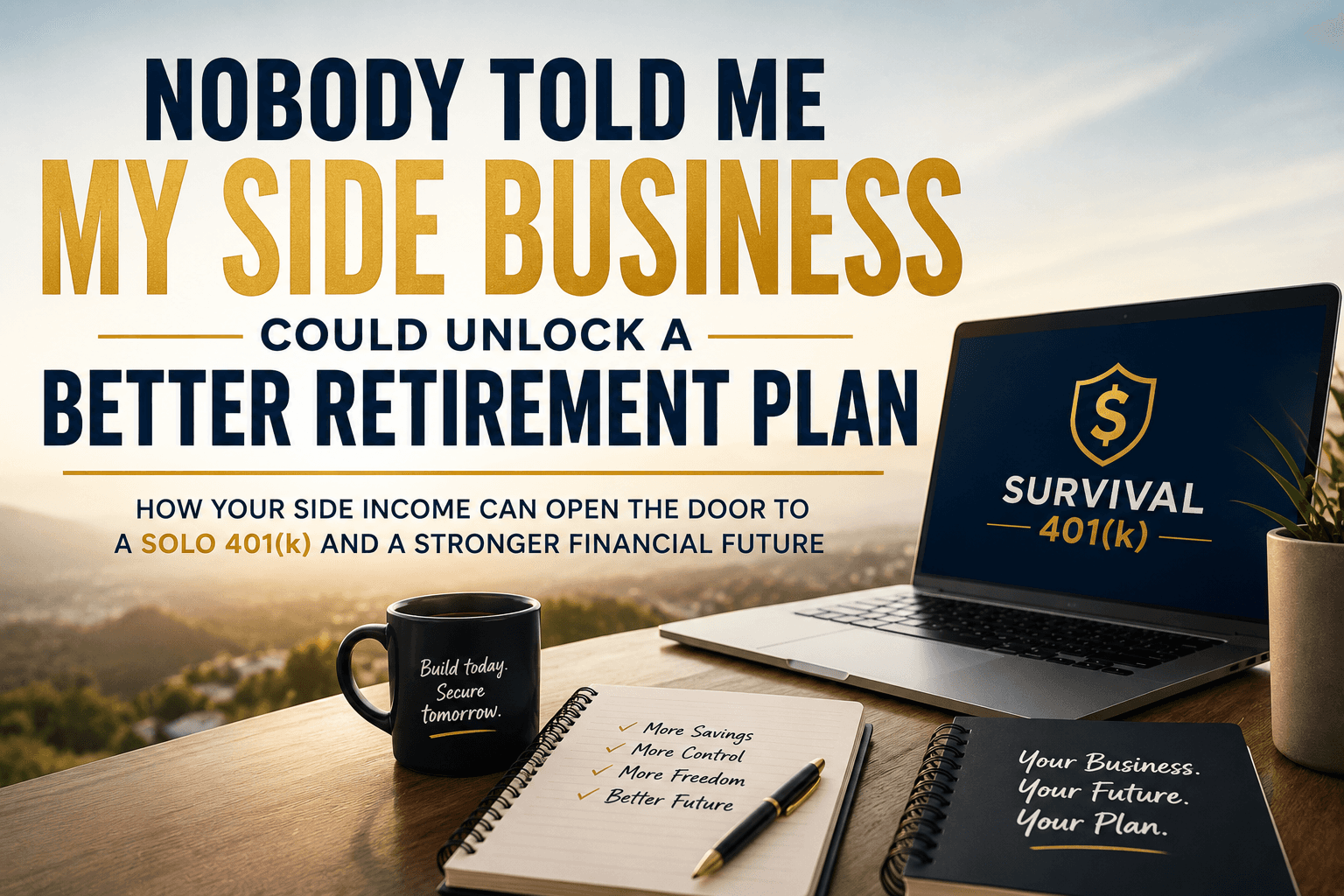
Nobody Told Me My Side Business Could Unlock a Better Retirement Plan
Millions of Americans have a side business, freelance, consult, sell products online, or earn income from a passion project—but many don't realize that this extra income may qualify them for a powerful retirement savings opportunity. If you have eligible self-employment income, a Solo 401(k) could offer benefits beyond what many traditional retirement accounts provide, including the potential for higher contribution opportunities, expanded investment flexibility, and the ability to roll over eligible retirement assets from former employer plans. In this guide, we'll explain how a side business may unlock access to a Solo 401(k), who may qualify, and why it's worth exploring if you're building income outside of your full-time job.
Search
Search
Category

Any Question?
Let’s talk

Any Question?
Let’s talk
Search
Search
Category

Any Question?
Let’s talk
The Retirement Opportunity Most Side Hustlers Never Hear About
When people think about retirement planning, they usually picture one of two things:
A 401(k) offered by their employer.
An IRA they opened on their own.
What many people don't realize is that having a side business—even one that isn't your primary source of income—may open the door to another retirement planning option: the Solo 401(k).
Whether you're freelancing on weekends, running an online store, consulting after work, or earning money from a passion project, your side business could provide access to retirement planning opportunities that many employees never know exist.
For eligible business owners, this can be one of the most valuable financial advantages of being self-employed.
The Rise of the Side Hustle
Over the last decade, side businesses have become increasingly common.
People are earning additional income through:
Freelance consulting
Graphic design
Photography
Real estate commissions
Online stores
Amazon businesses
Etsy shops
YouTube channels
Social media content creation
Coaching
Personal training
Landscaping
Home services
Bookkeeping
Software development
Ride-share driving
Delivery services
Pet care
Virtual assistance
And countless other businesses
Some side businesses generate a few thousand dollars per year.
Others eventually grow into full-time companies.
Regardless of size, eligible self-employment income may provide retirement planning opportunities many people never expected.
"I Thought I Needed to Be Self-Employed Full-Time"
This is probably the biggest misconception surrounding Solo 401(k)s.
Many people assume they must quit their job before they can open one.
That's simply not true.
If you have:
A full-time W-2 job and
Eligible self-employment income from your own business,
you may qualify for a Solo 401(k), provided you meet the plan's eligibility requirements.
Your side business doesn't have to replace your salary.
It simply needs to be a legitimate business generating self-employment income.
What Is a Solo 401(k)?
A Solo 401(k), sometimes called an Individual 401(k), is a retirement plan designed for self-employed individuals and business owners who have no common-law full-time employees other than themselves and, if applicable, their spouse.
Unlike many traditional retirement accounts, a Solo 401(k) allows eligible participants to contribute in two capacities:
As the employee.
As the employer.
This structure can create greater retirement savings opportunities than many people expect, subject to IRS contribution limits and eligibility requirements.
Who May Qualify?
Many people qualify without realizing it.
Examples include:
Realtors
Consultants
Freelancers
Independent contractors
Online business owners
Influencers
Coaches
Accountants
Attorneys
Dentists
Physicians
Electricians
Plumbers
Landscapers
Truck drivers
Farmers
Musicians
Authors
Speakers
Photographers
Even if your business is relatively new, it's worth determining whether you meet the eligibility requirements.
Your Side Business Can Do More Than Generate Extra Income
Many people think of a side business simply as a way to earn extra spending money.
But it can also become an important part of your long-term financial strategy.
Your business may help you:
Increase retirement savings.
Build long-term wealth.
Diversify income sources.
Create future financial flexibility.
Prepare for eventual retirement.
In other words, your side business isn't just producing income today—it may also help strengthen your financial future.
Benefits of a Solo 401(k)
Higher Contribution Opportunities
One of the biggest advantages of a Solo 401(k) is that eligible participants may be able to make both employee elective deferrals and employer profit-sharing contributions, subject to IRS limits.
This can create greater retirement savings opportunities than many people expect.
Investment Flexibility
Many employer-sponsored retirement plans offer a limited investment menu.
Many self-directed Solo 401(k) plans, on the other hand, provide access to a much broader range of permitted investments.
Depending on your plan and IRS rules, investment options may include:
Stocks
ETFs
Mutual funds
Bonds
Real estate
Private lending
Certain IRS-approved precious metals
Private businesses
Tax liens
Notes
And many other permitted investments
Checkbook Control
Many self-directed Solo 401(k) plans include checkbook control.
This allows the trustee to make qualified investments directly through the plan's bank account rather than waiting for approval on every transaction.
For active investors, this can provide greater efficiency and flexibility.
Participant Loan Feature
Many Solo 401(k) plans include participant loan provisions.
If permitted by the plan and within IRS limits, this feature may allow participants to borrow from their retirement account under specific repayment requirements.
Traditional IRAs generally do not offer this feature.
Roth Option
Many Solo 401(k) plans also include a Roth component.
This provides additional flexibility when planning for taxes in retirement.

Already Have a 401(k) at Work?
That's okay.
Many people are surprised to learn they may participate in:
Their employer's 401(k)
Their own Solo 401(k)
at the same time, provided they qualify.
Keep in mind that IRS contribution rules apply across certain retirement plans, so contribution planning should be coordinated carefully.
Your Old 401(k) Could Also Be Part of the Picture
Many side-business owners have changed jobs several times throughout their careers.
That often means they have retirement accounts scattered across former employers.
If you've separated from your previous employer, you may be able to roll eligible assets from a traditional employer-sponsored 401(k) into your Solo 401(k), provided your plan accepts rollovers and IRS rules are met.
Benefits may include:
Easier account management.
Consolidated retirement savings.
Greater investment flexibility.
Simplified recordkeeping.
One long-term retirement strategy.
Imagine This Scenario
Sarah works full-time as a marketing manager.
On evenings and weekends, she runs a successful wedding photography business.
At first, the income from photography helped pay for vacations.
As her business grew, she realized she qualified for a Solo 401(k).
Now she can:
Continue participating in her employer's retirement plan.
Save for retirement through her business.
Build additional retirement assets.
Explore a broader range of investment opportunities available through her self-directed Solo 401(k), if appropriate.
Potentially roll over eligible assets from former employer retirement plans in the future.
What started as a side hustle became an important part of her retirement strategy.
Common Myths
"I Don't Make Enough."
Your contribution amount depends on your business income, but there is no requirement that your business replace your full-time salary before you can explore a Solo 401(k).
"It's Only for Big Businesses."
Solo 401(k)s were specifically designed for self-employed individuals and qualifying small business owners.
"I'll Wait Until My Business Grows."
Waiting means delaying potential retirement savings opportunities.
Many people begin while their business is still relatively small.
"My W-2 Job Already Has a 401(k)."
That doesn't necessarily prevent you from establishing a Solo 401(k) for eligible self-employment income.
Is a Solo 401(k) Right for Every Side Business?
Not necessarily.
Your eligibility depends on:
Having qualifying self-employment income.
Meeting plan requirements.
Your business structure.
Your overall retirement goals.
IRS contribution rules.
A qualified tax professional or Solo 401(k) provider can help determine whether it's a good fit for your situation.
Questions to Ask Yourself
If you have a side business, consider these questions:
Am I earning self-employment income?
Am I saving enough for retirement?
Could I benefit from additional retirement savings opportunities?
Do I want greater investment flexibility?
Do I have old employer retirement accounts that could potentially be consolidated?
Am I thinking long-term about my financial future?
If you answered "yes" to several of these, it may be worth learning more about whether a Solo 401(k) fits your goals.
Frequently Asked Questions
Do I need to quit my full-time job?
No. Many Solo 401(k) owners continue working full-time while operating a qualifying side business.
Does my side business need to earn a lot of money?
No specific income threshold is required simply to establish eligibility, although your business income will affect contribution calculations.
Can I have both my employer's 401(k) and a Solo 401(k)?
Potentially, yes. Many individuals participate in both plans while following applicable IRS contribution rules.
Can I roll an old employer's 401(k) into my Solo 401(k)?
If you've separated from your employer, your Solo 401(k) accepts rollovers, and IRS requirements are satisfied, you may be able to roll eligible assets into your Solo 401(k).
Final Thoughts
Your side business may be doing far more than generating extra income—it could be opening the door to retirement planning opportunities you didn't know were available.
For eligible entrepreneurs, freelancers, consultants, and side hustlers, a Solo 401(k) can provide flexibility, expanded investment choices, and additional retirement savings opportunities that complement other retirement plans.
Many people spend years building a side business without realizing it can also become a powerful tool for building long-term financial security. Taking the time to understand your options today could help you make more informed decisions for tomorrow.
If you have qualifying self-employment income, exploring whether a Solo 401(k) fits your retirement strategy may be one of the smartest financial conversations you have.
Disclaimer
This article is for educational purposes only and should not be considered legal, tax, financial, or investment advice. Eligibility, contribution limits, rollover rules, and investment options for Solo 401(k) plans are subject to IRS regulations and individual circumstances.
The Retirement Opportunity Most Side Hustlers Never Hear About
When people think about retirement planning, they usually picture one of two things:
A 401(k) offered by their employer.
An IRA they opened on their own.
What many people don't realize is that having a side business—even one that isn't your primary source of income—may open the door to another retirement planning option: the Solo 401(k).
Whether you're freelancing on weekends, running an online store, consulting after work, or earning money from a passion project, your side business could provide access to retirement planning opportunities that many employees never know exist.
For eligible business owners, this can be one of the most valuable financial advantages of being self-employed.
The Rise of the Side Hustle
Over the last decade, side businesses have become increasingly common.
People are earning additional income through:
Freelance consulting
Graphic design
Photography
Real estate commissions
Online stores
Amazon businesses
Etsy shops
YouTube channels
Social media content creation
Coaching
Personal training
Landscaping
Home services
Bookkeeping
Software development
Ride-share driving
Delivery services
Pet care
Virtual assistance
And countless other businesses
Some side businesses generate a few thousand dollars per year.
Others eventually grow into full-time companies.
Regardless of size, eligible self-employment income may provide retirement planning opportunities many people never expected.
"I Thought I Needed to Be Self-Employed Full-Time"
This is probably the biggest misconception surrounding Solo 401(k)s.
Many people assume they must quit their job before they can open one.
That's simply not true.
If you have:
A full-time W-2 job and
Eligible self-employment income from your own business,
you may qualify for a Solo 401(k), provided you meet the plan's eligibility requirements.
Your side business doesn't have to replace your salary.
It simply needs to be a legitimate business generating self-employment income.
What Is a Solo 401(k)?
A Solo 401(k), sometimes called an Individual 401(k), is a retirement plan designed for self-employed individuals and business owners who have no common-law full-time employees other than themselves and, if applicable, their spouse.
Unlike many traditional retirement accounts, a Solo 401(k) allows eligible participants to contribute in two capacities:
As the employee.
As the employer.
This structure can create greater retirement savings opportunities than many people expect, subject to IRS contribution limits and eligibility requirements.
Who May Qualify?
Many people qualify without realizing it.
Examples include:
Realtors
Consultants
Freelancers
Independent contractors
Online business owners
Influencers
Coaches
Accountants
Attorneys
Dentists
Physicians
Electricians
Plumbers
Landscapers
Truck drivers
Farmers
Musicians
Authors
Speakers
Photographers
Even if your business is relatively new, it's worth determining whether you meet the eligibility requirements.
Your Side Business Can Do More Than Generate Extra Income
Many people think of a side business simply as a way to earn extra spending money.
But it can also become an important part of your long-term financial strategy.
Your business may help you:
Increase retirement savings.
Build long-term wealth.
Diversify income sources.
Create future financial flexibility.
Prepare for eventual retirement.
In other words, your side business isn't just producing income today—it may also help strengthen your financial future.
Benefits of a Solo 401(k)
Higher Contribution Opportunities
One of the biggest advantages of a Solo 401(k) is that eligible participants may be able to make both employee elective deferrals and employer profit-sharing contributions, subject to IRS limits.
This can create greater retirement savings opportunities than many people expect.
Investment Flexibility
Many employer-sponsored retirement plans offer a limited investment menu.
Many self-directed Solo 401(k) plans, on the other hand, provide access to a much broader range of permitted investments.
Depending on your plan and IRS rules, investment options may include:
Stocks
ETFs
Mutual funds
Bonds
Real estate
Private lending
Certain IRS-approved precious metals
Private businesses
Tax liens
Notes
And many other permitted investments
Checkbook Control
Many self-directed Solo 401(k) plans include checkbook control.
This allows the trustee to make qualified investments directly through the plan's bank account rather than waiting for approval on every transaction.
For active investors, this can provide greater efficiency and flexibility.
Participant Loan Feature
Many Solo 401(k) plans include participant loan provisions.
If permitted by the plan and within IRS limits, this feature may allow participants to borrow from their retirement account under specific repayment requirements.
Traditional IRAs generally do not offer this feature.
Roth Option
Many Solo 401(k) plans also include a Roth component.
This provides additional flexibility when planning for taxes in retirement.

Already Have a 401(k) at Work?
That's okay.
Many people are surprised to learn they may participate in:
Their employer's 401(k)
Their own Solo 401(k)
at the same time, provided they qualify.
Keep in mind that IRS contribution rules apply across certain retirement plans, so contribution planning should be coordinated carefully.
Your Old 401(k) Could Also Be Part of the Picture
Many side-business owners have changed jobs several times throughout their careers.
That often means they have retirement accounts scattered across former employers.
If you've separated from your previous employer, you may be able to roll eligible assets from a traditional employer-sponsored 401(k) into your Solo 401(k), provided your plan accepts rollovers and IRS rules are met.
Benefits may include:
Easier account management.
Consolidated retirement savings.
Greater investment flexibility.
Simplified recordkeeping.
One long-term retirement strategy.
Imagine This Scenario
Sarah works full-time as a marketing manager.
On evenings and weekends, she runs a successful wedding photography business.
At first, the income from photography helped pay for vacations.
As her business grew, she realized she qualified for a Solo 401(k).
Now she can:
Continue participating in her employer's retirement plan.
Save for retirement through her business.
Build additional retirement assets.
Explore a broader range of investment opportunities available through her self-directed Solo 401(k), if appropriate.
Potentially roll over eligible assets from former employer retirement plans in the future.
What started as a side hustle became an important part of her retirement strategy.
Common Myths
"I Don't Make Enough."
Your contribution amount depends on your business income, but there is no requirement that your business replace your full-time salary before you can explore a Solo 401(k).
"It's Only for Big Businesses."
Solo 401(k)s were specifically designed for self-employed individuals and qualifying small business owners.
"I'll Wait Until My Business Grows."
Waiting means delaying potential retirement savings opportunities.
Many people begin while their business is still relatively small.
"My W-2 Job Already Has a 401(k)."
That doesn't necessarily prevent you from establishing a Solo 401(k) for eligible self-employment income.
Is a Solo 401(k) Right for Every Side Business?
Not necessarily.
Your eligibility depends on:
Having qualifying self-employment income.
Meeting plan requirements.
Your business structure.
Your overall retirement goals.
IRS contribution rules.
A qualified tax professional or Solo 401(k) provider can help determine whether it's a good fit for your situation.
Questions to Ask Yourself
If you have a side business, consider these questions:
Am I earning self-employment income?
Am I saving enough for retirement?
Could I benefit from additional retirement savings opportunities?
Do I want greater investment flexibility?
Do I have old employer retirement accounts that could potentially be consolidated?
Am I thinking long-term about my financial future?
If you answered "yes" to several of these, it may be worth learning more about whether a Solo 401(k) fits your goals.
Frequently Asked Questions
Do I need to quit my full-time job?
No. Many Solo 401(k) owners continue working full-time while operating a qualifying side business.
Does my side business need to earn a lot of money?
No specific income threshold is required simply to establish eligibility, although your business income will affect contribution calculations.
Can I have both my employer's 401(k) and a Solo 401(k)?
Potentially, yes. Many individuals participate in both plans while following applicable IRS contribution rules.
Can I roll an old employer's 401(k) into my Solo 401(k)?
If you've separated from your employer, your Solo 401(k) accepts rollovers, and IRS requirements are satisfied, you may be able to roll eligible assets into your Solo 401(k).
Final Thoughts
Your side business may be doing far more than generating extra income—it could be opening the door to retirement planning opportunities you didn't know were available.
For eligible entrepreneurs, freelancers, consultants, and side hustlers, a Solo 401(k) can provide flexibility, expanded investment choices, and additional retirement savings opportunities that complement other retirement plans.
Many people spend years building a side business without realizing it can also become a powerful tool for building long-term financial security. Taking the time to understand your options today could help you make more informed decisions for tomorrow.
If you have qualifying self-employment income, exploring whether a Solo 401(k) fits your retirement strategy may be one of the smartest financial conversations you have.
Disclaimer
This article is for educational purposes only and should not be considered legal, tax, financial, or investment advice. Eligibility, contribution limits, rollover rules, and investment options for Solo 401(k) plans are subject to IRS regulations and individual circumstances.