
by
Garrett Clark

Retirement Planning
W-2 + 1099 Income? Here’s How to Maximize Both Plans
If you earn both W-2 and 1099 income, you have unique opportunities to maximize retirement contributions and reduce taxes. This blog breaks down how to strategically use a workplace 401(k) and a Solo 401(k) together, helping you take advantage of higher contribution limits, employer contributions, and flexible tax strategies to build long-term wealth.

Search
Search
Category

Any Question?
Let’s talk
Any Question?
Let’s talk
Search
Search
Category
Any Question?
Let’s talk
More professionals than ever are earning income from two worlds. You might have a full-time W-2 job with benefits while also running a side business, consulting, investing in real estate, coaching, freelancing, or operating an LLC that generates 1099 income.
The good news is this: having both income types creates powerful retirement planning opportunities—if structured correctly.
When used strategically, a W-2 401(k) and a Solo 401(k) can work together to help you reduce taxes, increase contributions, and build long-term wealth faster than most people realize.
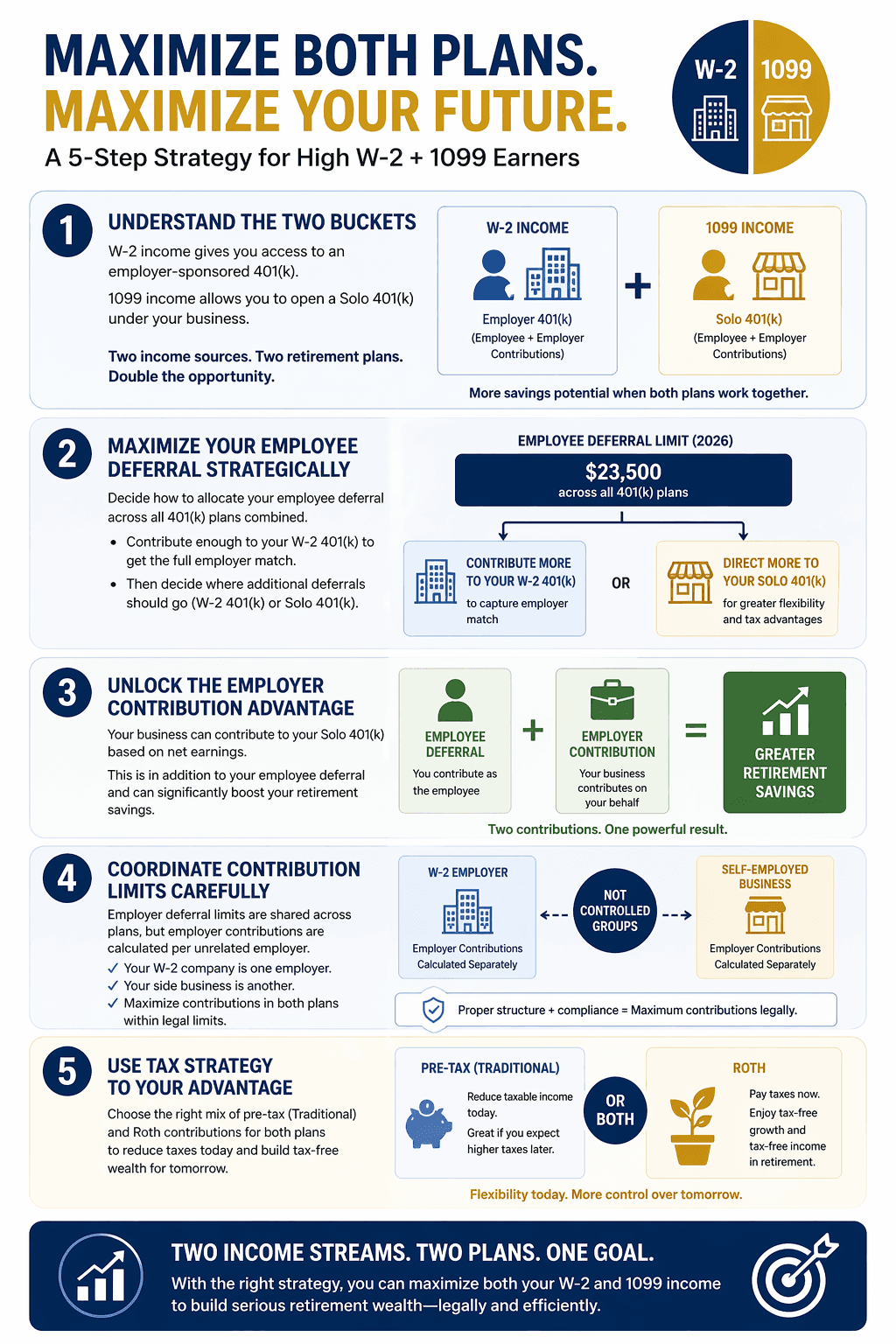
Step 1: Understand the Two Buckets
When you earn W-2 income, you typically have access to an employer-sponsored 401(k). For 2026, you can contribute up to the annual employee deferral limit across all 401(k) plans combined. This employee limit is shared, meaning you cannot double-dip between plans.
Your 1099 income, however, allows you to open a Solo 401(k) under your business. With a Solo 401(k), you wear two hats:
Employee
Employer
This creates a second opportunity to contribute beyond just your employee deferrals and is where the real advantage begins.
Step 2: Maximize Your Employee Deferral Strategically
The priority is deciding where to allocate your employee contributions.
Because the employee deferral limit applies across all 401(k) plans combined, you must be strategic with how you use it.
In most cases, it makes sense to:
Contribute enough to your W-2 401(k) to capture the full employer match (this is essentially free money)
Then evaluate whether additional contributions should go into your employer plan or your Solo 401(k)
If your employer plan has limited investment options or higher fees, you may benefit from directing remaining contributions into your Solo 401(k), assuming you have sufficient self-employment income to support it.
Step 3: Unlock the Employer Contribution Advantage
This is where the biggest opportunity exists.
Your W-2 employer may offer matching or profit-sharing contributions, which is great. However, this does not prevent you from making employer contributions to your Solo 401(k).
With your 1099 income, your business can make employer contributions based on net earnings. These contributions are separate from your employee deferral and can significantly increase your total retirement savings.
This means you can potentially:
Receive employer contributions from your W-2 job
Make additional employer contributions through your Solo 401(k)
Stay within IRS limits while maximizing total contributions
This dual contribution strategy is one of the most underutilized wealth-building tools available to high-performing professionals.
Step 4: Coordinate Contribution Limits Carefully
While the employee deferral limit is shared across all plans, employer contributions are calculated separately per unrelated employer.
Your W-2 employer is one entity.
Your business is another.
As long as the two are not considered a controlled group under IRS rules, you can maximize employer contributions in both plans within legal limits.
This is where structure and compliance become critical. Miscalculations can lead to excess contributions and penalties, while a properly structured strategy can significantly accelerate wealth building.
Working with a knowledgeable provider and CPA ensures you are optimizing your plan correctly.
Step 5: Use Tax Strategy to Your Advantage
One of the most powerful benefits of having both W-2 and 1099 income is tax flexibility.
With a Solo 401(k), you can choose between:
Pre-tax contributions (which reduce your taxable income today)
Roth contributions (which allow for tax-free withdrawals later, subject to IRS rules)
If you have high W-2 income, pre-tax Solo 401(k) contributions can help offset additional taxable income from your business.
If you expect higher tax rates in the future, Roth contributions may provide long-term advantages.
Having both income streams allows you to blend strategies and manage both your current tax liability and future tax exposure.
Step 6: Optimize Investment Flexibility
Another overlooked advantage is investment control.
Most employer-sponsored 401(k) plans are limited to a small selection of mutual funds. A properly structured Solo 401(k), however, can offer broader investment flexibility, including:
Stocks and ETFs
Real estate
Private lending
Alternative assets
This allows you to align your investments with your knowledge, risk tolerance, and long-term strategy rather than being limited to pre-selected options.
Step 7: Build a Long-Term Wealth Strategy
Combining W-2 and 1099 income is not just about maximizing contributions for one year. It is about building a repeatable system for long-term wealth creation.
By consistently:
Capturing employer matches
Maximizing employer contributions
Reducing taxable income
Investing strategically
You can create a compounding effect that significantly improves your financial position over time.
Bringing It All Together
Having both W-2 and 1099 income puts you in a unique position. Most people only have access to one retirement plan, but you have the ability to leverage two.
With the right structure, you can:
Contribute more
Reduce taxes
Gain greater investment control
Build wealth faster
The key is understanding how the rules work together and using them intentionally.
This content is for educational and informational purposes only and should not be considered tax, legal, or financial advice.
More professionals than ever are earning income from two worlds. You might have a full-time W-2 job with benefits while also running a side business, consulting, investing in real estate, coaching, freelancing, or operating an LLC that generates 1099 income.
The good news is this: having both income types creates powerful retirement planning opportunities—if structured correctly.
When used strategically, a W-2 401(k) and a Solo 401(k) can work together to help you reduce taxes, increase contributions, and build long-term wealth faster than most people realize.
Step 1: Understand the Two Buckets
When you earn W-2 income, you typically have access to an employer-sponsored 401(k). For 2026, you can contribute up to the annual employee deferral limit across all 401(k) plans combined. This employee limit is shared, meaning you cannot double-dip between plans.
Your 1099 income, however, allows you to open a Solo 401(k) under your business. With a Solo 401(k), you wear two hats:
Employee
Employer
This creates a second opportunity to contribute beyond just your employee deferrals and is where the real advantage begins.
Step 2: Maximize Your Employee Deferral Strategically
The priority is deciding where to allocate your employee contributions.
Because the employee deferral limit applies across all 401(k) plans combined, you must be strategic with how you use it.
In most cases, it makes sense to:
Contribute enough to your W-2 401(k) to capture the full employer match (this is essentially free money)
Then evaluate whether additional contributions should go into your employer plan or your Solo 401(k)
If your employer plan has limited investment options or higher fees, you may benefit from directing remaining contributions into your Solo 401(k), assuming you have sufficient self-employment income to support it.
Step 3: Unlock the Employer Contribution Advantage
This is where the biggest opportunity exists.
Your W-2 employer may offer matching or profit-sharing contributions, which is great. However, this does not prevent you from making employer contributions to your Solo 401(k).
With your 1099 income, your business can make employer contributions based on net earnings. These contributions are separate from your employee deferral and can significantly increase your total retirement savings.
This means you can potentially:
Receive employer contributions from your W-2 job
Make additional employer contributions through your Solo 401(k)
Stay within IRS limits while maximizing total contributions
This dual contribution strategy is one of the most underutilized wealth-building tools available to high-performing professionals.
Step 4: Coordinate Contribution Limits Carefully
While the employee deferral limit is shared across all plans, employer contributions are calculated separately per unrelated employer.
Your W-2 employer is one entity.
Your business is another.
As long as the two are not considered a controlled group under IRS rules, you can maximize employer contributions in both plans within legal limits.
This is where structure and compliance become critical. Miscalculations can lead to excess contributions and penalties, while a properly structured strategy can significantly accelerate wealth building.
Working with a knowledgeable provider and CPA ensures you are optimizing your plan correctly.
Step 5: Use Tax Strategy to Your Advantage
One of the most powerful benefits of having both W-2 and 1099 income is tax flexibility.
With a Solo 401(k), you can choose between:
Pre-tax contributions (which reduce your taxable income today)
Roth contributions (which allow for tax-free withdrawals later, subject to IRS rules)
If you have high W-2 income, pre-tax Solo 401(k) contributions can help offset additional taxable income from your business.
If you expect higher tax rates in the future, Roth contributions may provide long-term advantages.
Having both income streams allows you to blend strategies and manage both your current tax liability and future tax exposure.
Step 6: Optimize Investment Flexibility
Another overlooked advantage is investment control.
Most employer-sponsored 401(k) plans are limited to a small selection of mutual funds. A properly structured Solo 401(k), however, can offer broader investment flexibility, including:
Stocks and ETFs
Real estate
Private lending
Alternative assets
This allows you to align your investments with your knowledge, risk tolerance, and long-term strategy rather than being limited to pre-selected options.
Step 7: Build a Long-Term Wealth Strategy
Combining W-2 and 1099 income is not just about maximizing contributions for one year. It is about building a repeatable system for long-term wealth creation.
By consistently:
Capturing employer matches
Maximizing employer contributions
Reducing taxable income
Investing strategically
You can create a compounding effect that significantly improves your financial position over time.
Bringing It All Together
Having both W-2 and 1099 income puts you in a unique position. Most people only have access to one retirement plan, but you have the ability to leverage two.
With the right structure, you can:
Contribute more
Reduce taxes
Gain greater investment control
Build wealth faster
The key is understanding how the rules work together and using them intentionally.
This content is for educational and informational purposes only and should not be considered tax, legal, or financial advice.