
by
Garrett Clark

Wealth Management
When You Can Take Solo 401(k) Distributions Without Penalties, How They’re Taxed, and When RMDs Apply
Understanding how and when to take distributions from your Solo 401(k) can make a major difference in your long-term financial outcome. This guide breaks down the key rules around penalty-free withdrawals, how distributions are taxed, and when Required Minimum Distributions (RMDs) begin. It also covers important strategies to help reduce taxes, avoid costly mistakes, and plan effectively for retirement. Whether you are approaching retirement age or simply planning ahead, this article provides a clear and practical overview to help you stay compliant and in control of your Solo 401(k).

Search
Search
Category

Any Question?
Let’s talk
Any Question?
Let’s talk
Search
Search
Category
Any Question?
Let’s talk
Understanding when and how you can access your Solo 401(k) is one of the most important parts of retirement planning. Taking distributions at the wrong time or in the wrong way can lead to unnecessary taxes and penalties, while a well-planned strategy can help you maximize your wealth and maintain flexibility.
This guide breaks down when you can take distributions, how they are taxed, and when Required Minimum Distributions (RMDs) apply.
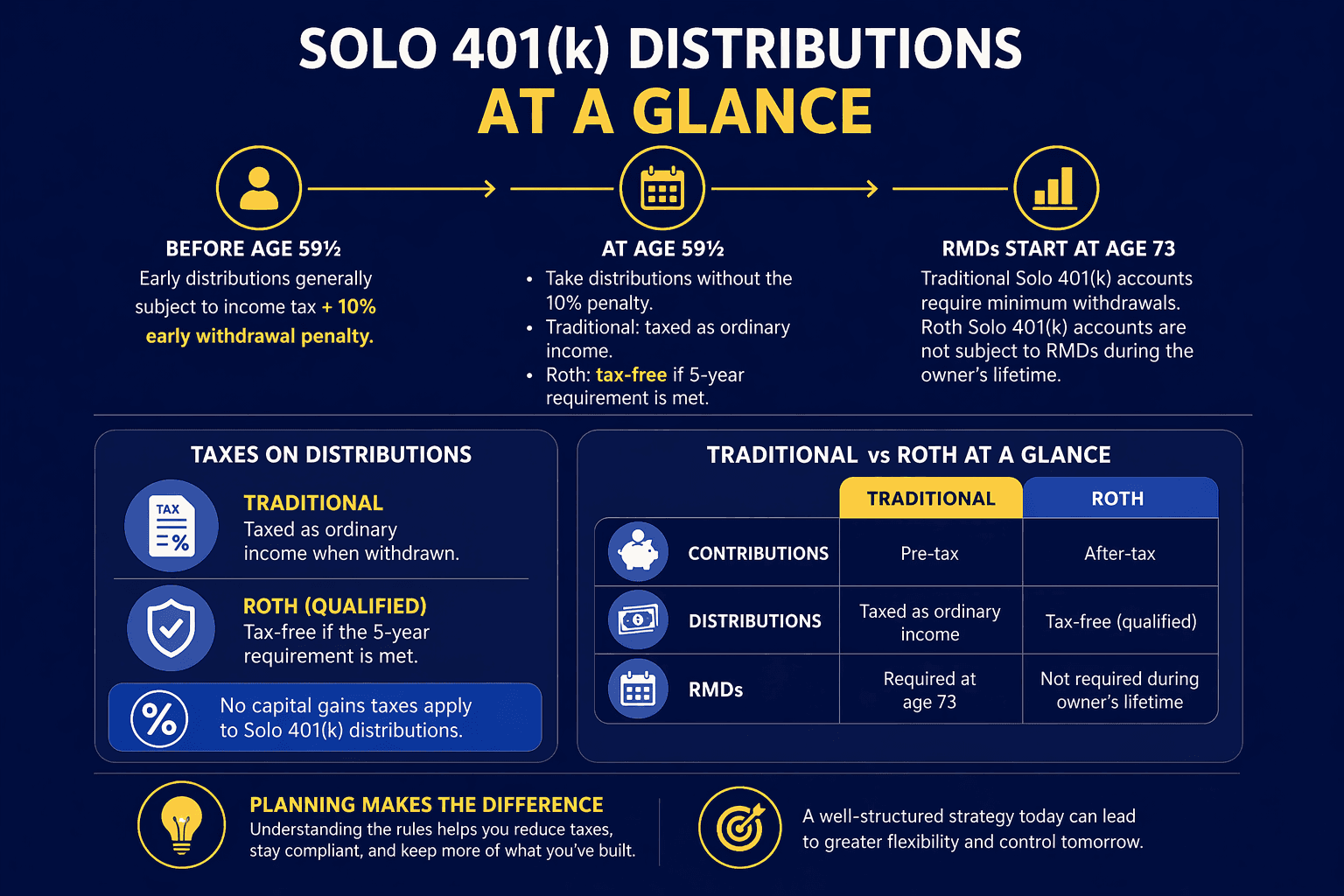
Before Age 59½: Early Distributions
In most cases, taking money out of your Solo 401(k) before age 59½ is considered an early distribution.
These withdrawals are typically:
Subject to ordinary income tax
Subject to an additional 10% early withdrawal penalty
Possible Exceptions
There are limited exceptions where the 10% penalty may not apply, including:
Disability
Certain medical expenses
Qualified birth or adoption expenses
Substantially Equal Periodic Payments (SEPP)
Even with exceptions, early withdrawals should be approached carefully since they reduce long-term retirement growth.
At Age 59½: Penalty-Free Access
Once you reach age 59½, you can begin taking distributions from your Solo 401(k) without the 10% penalty.
However, taxes still depend on the type of contributions:
Traditional Solo 401(k):
Distributions are taxed as ordinary income
Roth Solo 401(k):
Distributions may be tax-free if:
The account has been open for at least 5 years
You meet the qualified distribution requirements
This is the most common stage where business owners begin using their retirement funds.
Required Minimum Distributions (RMDs)
Under current IRS rules, Traditional Solo 401(k) accounts require RMDs starting at age 73.
Key Points:
RMDs are mandatory withdrawals
They are taxed as ordinary income
Failing to take RMDs can result in significant penalties
Roth Solo 401(k) Note:
Roth Solo 401(k)s are also subject to RMDs during the owner’s lifetime
Many individuals choose to roll Roth 401(k) funds into a Roth IRA, which does not require lifetime RMDs
Taxes on Solo 401(k) Distributions
Understanding taxation is critical when planning withdrawals:
Traditional Contributions:
Taxed as ordinary income when withdrawn
Roth Contributions:
Qualified distributions are tax-free
No Capital Gains Treatment:
Distributions are not taxed at capital gains rates
Everything is treated as income (unless Roth-qualified)
Strategic Withdrawal Planning
How and when you take distributions can significantly impact your long-term wealth.
Key Strategies:
Spread withdrawals over multiple years to avoid higher tax brackets
Combine Traditional and Roth withdrawals for tax diversification
Delay withdrawals when possible to allow for continued tax-deferred growth
Consider rolling funds strategically to reduce RMD impact
What Happens When You Pass Away?
Your Solo 401(k) does not disappear. Instead, it passes to your named beneficiaries, and the rules change depending on who inherits it. The Solo 401(k) is out of probate as well.
Spouse Beneficiary:
Can take over the account as their own
Has full flexibility with distributions
Non-Spouse Beneficiaries (e.g., Children):
Must follow the 10-year rule
The full account must be distributed within 10 years
Distributions are taxed as income (if Traditional)
If real estate or other assets are held inside the plan:
They may be sold and distributed as cash
Or distributed in-kind, which can create a large taxable event
Proper beneficiary planning is essential to avoid unnecessary taxes and complications.
Common Mistakes to Avoid
Taking early distributions without understanding penalties
Not planning for RMDs
Failing to diversify between Traditional and Roth
Not updating beneficiary designations
Holding illiquid assets without an exit strategy
Planning Makes the Difference
Knowing the rules is important, but having a strategy is what truly makes the difference.
A well-structured Solo 401(k) plan allows you to:
Stay compliant with IRS regulations
Minimize taxes over time
Maintain control over your investments
Build long-term wealth with flexibility
Final Thoughts
The Solo 401(k) is one of the most powerful retirement tools available to business owners and self-employed individuals. But with that control comes responsibility.
Understanding when you can take distributions, how they are taxed, and how to plan can make a significant difference in your financial future.
At Survival401k, our goal is to help you use your Solo 401(k) with confidence, clarity, and control.
This content is for educational purposes only and should not be considered tax, legal, or financial advice. Always consult with a qualified professional regarding your specific situation.
Understanding when and how you can access your Solo 401(k) is one of the most important parts of retirement planning. Taking distributions at the wrong time or in the wrong way can lead to unnecessary taxes and penalties, while a well-planned strategy can help you maximize your wealth and maintain flexibility.
This guide breaks down when you can take distributions, how they are taxed, and when Required Minimum Distributions (RMDs) apply.
Before Age 59½: Early Distributions
In most cases, taking money out of your Solo 401(k) before age 59½ is considered an early distribution.
These withdrawals are typically:
Subject to ordinary income tax
Subject to an additional 10% early withdrawal penalty
Possible Exceptions
There are limited exceptions where the 10% penalty may not apply, including:
Disability
Certain medical expenses
Qualified birth or adoption expenses
Substantially Equal Periodic Payments (SEPP)
Even with exceptions, early withdrawals should be approached carefully since they reduce long-term retirement growth.
At Age 59½: Penalty-Free Access
Once you reach age 59½, you can begin taking distributions from your Solo 401(k) without the 10% penalty.
However, taxes still depend on the type of contributions:
Traditional Solo 401(k):
Distributions are taxed as ordinary income
Roth Solo 401(k):
Distributions may be tax-free if:
The account has been open for at least 5 years
You meet the qualified distribution requirements
This is the most common stage where business owners begin using their retirement funds.
Required Minimum Distributions (RMDs)
Under current IRS rules, Traditional Solo 401(k) accounts require RMDs starting at age 73.
Key Points:
RMDs are mandatory withdrawals
They are taxed as ordinary income
Failing to take RMDs can result in significant penalties
Roth Solo 401(k) Note:
Roth Solo 401(k)s are also subject to RMDs during the owner’s lifetime
Many individuals choose to roll Roth 401(k) funds into a Roth IRA, which does not require lifetime RMDs
Taxes on Solo 401(k) Distributions
Understanding taxation is critical when planning withdrawals:
Traditional Contributions:
Taxed as ordinary income when withdrawn
Roth Contributions:
Qualified distributions are tax-free
No Capital Gains Treatment:
Distributions are not taxed at capital gains rates
Everything is treated as income (unless Roth-qualified)
Strategic Withdrawal Planning
How and when you take distributions can significantly impact your long-term wealth.
Key Strategies:
Spread withdrawals over multiple years to avoid higher tax brackets
Combine Traditional and Roth withdrawals for tax diversification
Delay withdrawals when possible to allow for continued tax-deferred growth
Consider rolling funds strategically to reduce RMD impact
What Happens When You Pass Away?
Your Solo 401(k) does not disappear. Instead, it passes to your named beneficiaries, and the rules change depending on who inherits it. The Solo 401(k) is out of probate as well.
Spouse Beneficiary:
Can take over the account as their own
Has full flexibility with distributions
Non-Spouse Beneficiaries (e.g., Children):
Must follow the 10-year rule
The full account must be distributed within 10 years
Distributions are taxed as income (if Traditional)
If real estate or other assets are held inside the plan:
They may be sold and distributed as cash
Or distributed in-kind, which can create a large taxable event
Proper beneficiary planning is essential to avoid unnecessary taxes and complications.
Common Mistakes to Avoid
Taking early distributions without understanding penalties
Not planning for RMDs
Failing to diversify between Traditional and Roth
Not updating beneficiary designations
Holding illiquid assets without an exit strategy
Planning Makes the Difference
Knowing the rules is important, but having a strategy is what truly makes the difference.
A well-structured Solo 401(k) plan allows you to:
Stay compliant with IRS regulations
Minimize taxes over time
Maintain control over your investments
Build long-term wealth with flexibility
Final Thoughts
The Solo 401(k) is one of the most powerful retirement tools available to business owners and self-employed individuals. But with that control comes responsibility.
Understanding when you can take distributions, how they are taxed, and how to plan can make a significant difference in your financial future.
At Survival401k, our goal is to help you use your Solo 401(k) with confidence, clarity, and control.
This content is for educational purposes only and should not be considered tax, legal, or financial advice. Always consult with a qualified professional regarding your specific situation.