Why a Solo 401(k) Is Often Better Than Traditional Retirement Accounts
By Garrett Clark
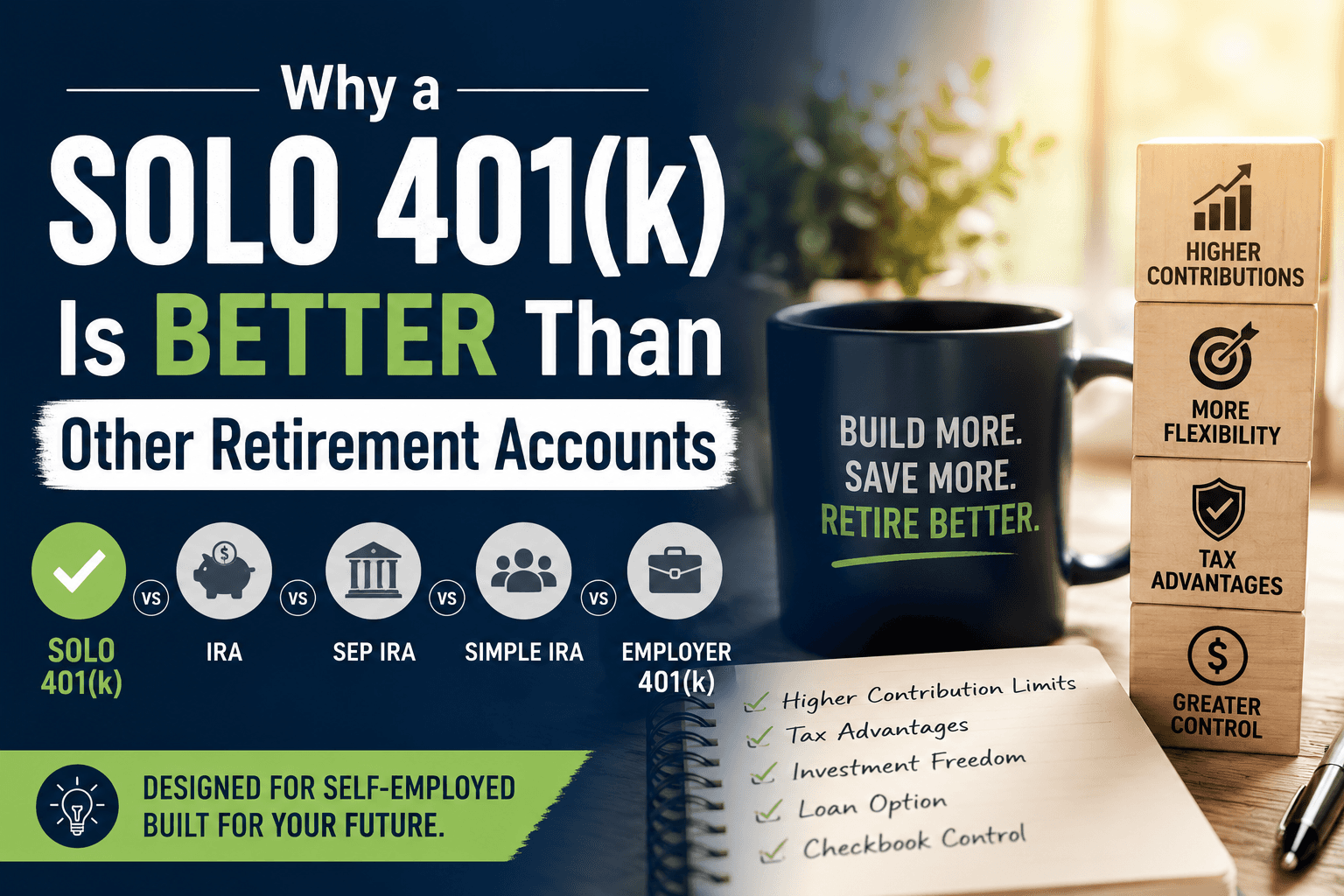
When most people think about retirement investing, they think about an IRA offered through a brokerage firm or a 401(k) through their employer. These accounts have helped millions of Americans prepare for retirement, but they aren't always the best option, especially for self-employed individuals.
If you own a business with no full-time employees (other than a spouse), a Solo 401(k) may offer advantages that traditional retirement accounts simply cannot match.
Higher contribution limits, flexible tax treatment, broader investment choices, loan provisions, and unique investment opportunities have made the Solo 401(k) one of the fastest-growing retirement plans among entrepreneurs.
Let's compare how the Solo 401(k) stacks up against Traditional IRAs, Roth IRAs, SEP IRAs, SIMPLE IRAs, and standard employer-sponsored retirement plans.
What Is a Solo 401(k)?
A Solo 401(k), sometimes called an Individual 401(k) or One-Participant 401(k), is a retirement plan specifically designed for self-employed individuals and business owners with no full-time employees other than themselves and, if applicable, their spouse.
Unlike many retirement accounts, the business owner acts as both:
Employee
Employer
Because of this dual role, contributions can come from both sides of the plan, dramatically increasing the amount that can be saved each year.
For high-income entrepreneurs, consultants, freelancers, real estate professionals, contractors, and small business owners, this creates opportunities that traditional retirement accounts simply don't offer.
Contribution Limits: The Biggest Advantage
One of the biggest differences between a Solo 401(k) and an IRA is how much you can contribute.
Traditional and Roth IRAs have relatively modest annual contribution limits.
A Solo 401(k), however, allows eligible business owners to contribute:
Employee salary deferrals
Employer profit-sharing contributions
When combined, these contributions can be substantially larger than what is allowed in an IRA, enabling faster retirement savings and potentially greater tax advantages.
For business owners earning significant income, the ability to shelter more money from current taxation (if making traditional contributions) can have a meaningful impact on long-term wealth accumulation.
Traditional IRA vs. Solo 401(k)
A Traditional IRA has been a retirement staple for decades.
Advantages include:
Easy to open
Widely available
Tax-deferred growth
Low minimum investment requirements
However, Traditional IRAs also have limitations.
Some drawbacks include:
Much lower contribution limits
Deductibility restrictions based on income and workplace retirement plans
Limited flexibility
No participant loan option
A Solo 401(k) generally provides:
Significantly higher contribution potential
Potential Roth contributions (if the plan allows)
Loan provisions (if included in the plan document)
Greater investment flexibility
Employer contribution opportunities
For many self-employed professionals, these additional features create a substantial advantage.
Roth IRA vs. Solo 401(k)
Roth IRAs are popular because qualified withdrawals in retirement are tax-free.
They're an excellent option for many investors.
However, Roth IRAs come with income eligibility restrictions.
Higher-income earners may be unable to contribute directly.
A Solo 401(k) can often include a Roth contribution feature without the same direct income eligibility restrictions that apply to Roth IRAs, allowing many business owners to make Roth salary deferrals while also making employer contributions on the traditional side, depending on applicable rules.
This creates additional tax planning flexibility.
SEP IRA vs. Solo 401(k)
The SEP IRA is another retirement account frequently used by self-employed individuals.
SEP IRAs are known for:
Simple administration
High contribution limits
Employer-funded contributions
However, there are important differences.
With a SEP IRA:
Contributions come only from the employer.
Employee salary deferrals are not permitted.
A Solo 401(k) allows both employee and employer contributions.
This often means that individuals with moderate business income can contribute more to a Solo 401(k) than they could to a SEP IRA.
Additionally, many Solo 401(k) plans offer features unavailable in SEP IRAs, such as:
Roth contributions
Participant loans
Alternative investment flexibility
SIMPLE IRA vs. Solo 401(k)
SIMPLE IRAs are commonly used by smaller businesses that have employees.
Benefits include:
Easy administration
Lower costs
Employee contributions
Employer matching
However:
Contribution limits are lower.
Investment flexibility may be more limited.
Loan provisions generally are not available.
For business owners without employees, the Solo 401(k) frequently provides greater retirement savings potential.
Employer 401(k) vs. Solo 401(k)
If you've previously worked for a larger company, you're likely familiar with a traditional employer-sponsored 401(k).
These plans often offer:
Payroll deductions
Employer matching
Professional investment management
However, employees typically have limited control over:
Investment options
Fees
Plan rules
Many employer plans restrict participants to a small menu of mutual funds or target-date funds.
A self-directed Solo 401(k) can offer much greater control over investment decisions, depending on the plan structure and custodian arrangements.
Investment Flexibility
Perhaps one of the biggest reasons investors choose a self-directed Solo 401(k) is investment flexibility.
Many traditional retirement accounts offered through brokerage firms primarily focus on:
Stocks
Mutual funds
ETFs
Bonds
A properly structured self-directed Solo 401(k) may also allow investments in:
Rental real estate
Raw land
Private lending
Private equity
Tax liens (where permitted)
Certain precious metals that meet IRS requirements
Cryptocurrency (through appropriate custodial arrangements, if permitted)
Notes
Trust deeds
LLC interests
This flexibility allows investors to build retirement portfolios that align with their experience and expertise.
Checkbook Control
Many self-directed Solo 401(k) plans include what's commonly called "checkbook control."
This means the retirement plan can often make investments directly through its own bank account without waiting for a custodian to approve every transaction.
Benefits may include:
Faster investment decisions
Less paperwork
Greater control
Easier real estate transactions
Simplified private lending
This feature is especially valuable for active real estate investors and entrepreneurs.
Participant Loan Feature
Another advantage unavailable in IRAs is the participant loan provision.
If the plan document allows loans, participants may generally borrow up to IRS limits from their own retirement account without triggering taxes or penalties, provided the loan complies with IRS rules and is repaid according to the plan's terms.
IRAs do not offer this feature.
While retirement savings should generally remain invested for retirement, having access to a loan provision can provide flexibility during unexpected financial situations.
Tax Planning Opportunities
One of the greatest strengths of a Solo 401(k) is tax flexibility.
Depending on the plan and your circumstances, you may be able to choose between:
Traditional contributions:
Reduce taxable income today.
Taxes paid during retirement distributions.
Roth contributions:
Taxes paid now.
Qualified withdrawals may be tax-free in retirement.
This flexibility allows business owners to work with their tax advisor to determine the most advantageous strategy each year.
Better for High-Income Business Owners
As income increases, retirement planning becomes increasingly important.
Business owners often look for ways to:
Reduce taxable income
Increase retirement savings
Diversify investments
Maintain greater control
The Solo 401(k) addresses all of these goals.
Rather than being limited by small IRA contribution caps, business owners may be able to invest substantially more toward retirement while potentially lowering their current tax burden through deductible traditional contributions.
More Control Over Your Retirement
Many investors dislike having retirement decisions made for them.
With a self-directed Solo 401(k), you generally control:
Investment selection
Timing
Diversification
Risk tolerance
Asset allocation
Instead of relying solely on mutual funds chosen by a brokerage firm, you can build a retirement strategy that reflects your knowledge and long-term goals.
Important Rules Still Apply
Despite its flexibility, the Solo 401(k) must still follow IRS rules.
Plan participants should avoid prohibited transactions, including:
Using retirement assets for personal benefit
Buying property for personal use
Lending money to disqualified persons
Selling personal property to the plan
Mixing personal and retirement funds
Maintaining proper records and working with experienced professionals can help ensure the plan remains compliant.
Who Should Consider a Solo 401(k)?
A Solo 401(k) may be an excellent fit for:
Freelancers
Consultants
Real estate investors
Independent contractors
Small business owners
Side-hustle entrepreneurs
Sole proprietors
Single-member LLC owners
S Corporation owners
Partnerships (when otherwise eligible)
Self-employed professionals
Husband-and-wife businesses with no eligible full-time employees
If you earn self-employment income, even on a part-time basis, you may qualify.
When Another Retirement Account May Be Better
Although the Solo 401(k) offers significant advantages, it's not the best solution for everyone.
For example:
Individuals without self-employment income generally aren't eligible.
Business owners with eligible full-time employees may need a different type of retirement plan.
Some investors who prefer a simple, hands-off approach may be satisfied with a traditional IRA or employer-sponsored plan.
Choosing the right retirement account depends on your income, business structure, long-term goals, and tax situation.
Final Thoughts
For many entrepreneurs and self-employed professionals, the Solo 401(k) stands out as one of the most versatile retirement plans available. Its combination of higher contribution potential, flexible tax options, expanded investment choices, participant loan provisions, and greater control over retirement assets makes it an attractive alternative to many traditional retirement accounts.
While IRAs, SEP IRAs, SIMPLE IRAs, and employer-sponsored 401(k) plans each have their place, a Solo 401(k) can unlock opportunities that are especially valuable for eligible business owners who want to maximize retirement savings while maintaining flexibility.
If you're self-employed or own a small business without eligible full-time employees, exploring whether a Solo 401(k) fits your financial strategy could be one of the most impactful retirement planning decisions you make.
Disclaimer
The information provided in this article is for educational purposes only and should not be considered legal, tax, accounting, or investment advice. Eligibility for a Solo 401(k), contribution limits, investment options, and plan features depend on your individual circumstances and current IRS regulations. Not every investment is appropriate for every investor, and alternative investments carry unique risks. Before establishing or making decisions regarding a retirement plan, consult with a qualified tax professional, financial advisor, or attorney to determine the strategy that best fits your specific financial goals and situation. Survival401k does not guarantee investment performance or future results.
This article is general education, not legal, tax, investment or accounting advice. Survival 401K is not a bank, custodian, registered investment adviser, law firm, CPA firm, lender or fiduciary, and does not recommend specific investments. Rules and figures change - confirm anything time-sensitive with your own adviser and with official IRS guidance.