
by
Garrett Clark

Solo Business Guidance
You’re Not “Too Small” for a Solo 401(k)
Most business owners wait too long to take advantage of one of the most powerful retirement tools available. Here’s why size doesn’t matter and why starting early can make all the difference.

Search
Search
Category

Any Question?
Let’s talk
Any Question?
Let’s talk
Search
Search
Category
Any Question?
Let’s talk
The Biggest Myth Small Business Owners Believe
One of the most common things business owners say when retirement planning comes up is, “I’m not big enough for that yet.”
There’s a widespread assumption that Solo 401(k)s are only for high-revenue companies, seasoned entrepreneurs, or individuals making six figures consistently. Because of that belief, many small business owners delay taking advantage of a strategy that was actually built for them.
The reality is very different.
Solo 401(k)s were designed specifically for small business owners, freelancers, independent contractors, and side-hustlers—not large corporations. In many cases, they are most powerful when started early, not later.
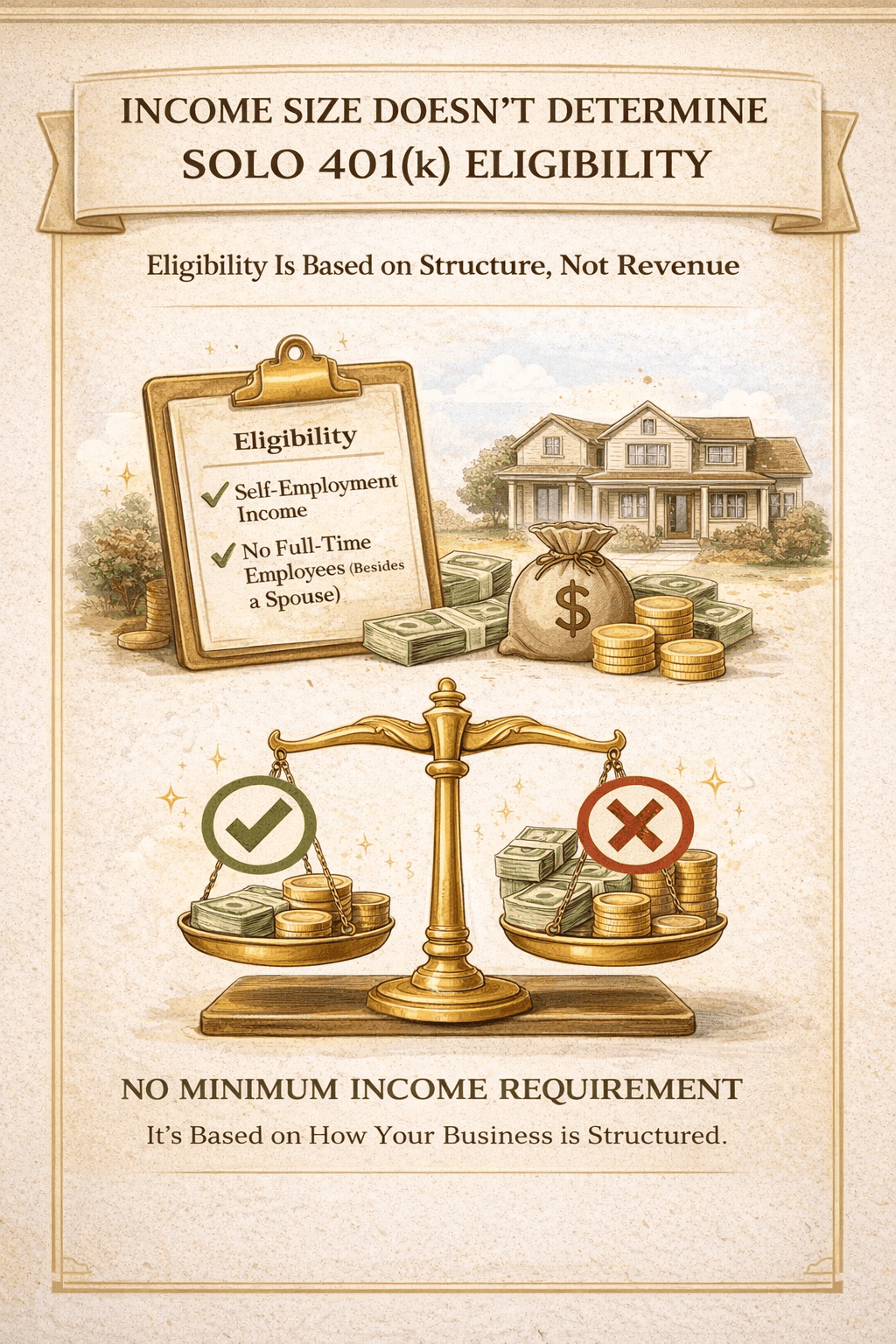
Eligibility Is About Structure, Not Revenue
A Solo 401(k) is not based on how much you make. It’s based on how your business is structured.
If you have:
Self-employment income
No full-time employees other than a spouse
You are likely eligible.
There is no minimum income requirement to qualify. Whether your business earns $10,000 or $300,000 per year, eligibility does not change. What matters is that you have qualifying earned income and operate without full-time staff.
Why Starting Early Beats Waiting
Many business owners delay setting up a Solo 401(k) because they believe they need to wait until their income increases.
But waiting often comes at a cost.
The advantage of a Solo 401(k) isn’t just higher contribution limits—it’s:
Time in the market
Tax-advantaged growth
Long-term compounding
Even modest contributions made early can grow significantly over time. Waiting for the “perfect” moment often results in missed opportunities that cannot be recovered.
More Flexibility Than Traditional Plans
A Solo 401(k) allows you to contribute as both:
The employee
The employer
This creates flexibility that most retirement accounts don’t offer.
You can:
Adjust contributions based on cash flow
Increase in strong years
Scale back when needed
This makes it ideal for:
Real estate investors
Commission-based earners
Seasonal or growing businesses
You are not locked into fixed contribution requirements.
A Powerful Tool for Real Estate Investors
For those in real estate, a Solo 401(k) can open additional opportunities.
It allows you to:
Invest in real estate inside a tax-advantaged account
Grow rental income within your retirement plan
Participate in private or alternative investments
Utilize strategies such as non-recourse lending
This turns your retirement account into a more active wealth-building vehicle rather than a passive one.
“Too Small” Often Means “Too Early”
Being “too small” is often confused with being “too early.”
Many entrepreneurs open Solo 401(k)s while:
Working full-time jobs
Building a side income
Growing early-stage businesses
This allows them to establish tax-efficient strategies and systems before their income scales.
By the time their business grows, they are already positioned to maximize it.
Build Habits That Scale With You
Starting early does more than just grow retirement savings. It builds structure.
It encourages:
Better financial discipline
Proactive tax planning
Long-term thinking
These habits grow alongside your business, helping you stay prepared as income increases.
A Solo 401(k) is a Tool, not a Milestone
A Solo 401(k) is not something you wait to qualify for later.
It is a tool designed to help you grow into the next level.
If you are self-employed and waiting to feel “big enough,” there’s a strong chance you already are.
Take the Next Step
If you have self-employment income and want to:
Reduce taxes
Build long-term wealth
Invest with more control
A Solo 401(k) may already be available to you.
👉 Learn more at: www.survival401k.com
This content is for educational and informational purposes only and should not be considered tax, legal, or financial advice.
A Powerful Tool for Real Estate Investors
For those in real estate, a Solo 401(k) can open additional opportunities.
It allows you to:
Invest in real estate inside a tax-advantaged account
Grow rental income within your retirement plan
Participate in private or alternative investments
Utilize strategies such as non-recourse lending
This turns your retirement account into a more active wealth-building vehicle rather than a passive one.
“Too Small” Often Means “Too Early”
Being “too small” is often confused with being “too early.”
Many entrepreneurs open Solo 401(k)s while:
Working full-time jobs
Building a side income
Growing early-stage businesses
This allows them to establish tax-efficient strategies and systems before their income scales.
By the time their business grows, they are already positioned to maximize it.
Build Habits That Scale With You
Starting early does more than just grow retirement savings. It builds structure.
It encourages:
Better financial discipline
Proactive tax planning
Long-term thinking
These habits grow alongside your business, helping you stay prepared as income increases.
A Solo 401(k) is a Tool, not a Milestone
A Solo 401(k) is not something you wait to qualify for later.
It is a tool designed to help you grow into the next level.
If you are self-employed and waiting to feel “big enough,” there’s a strong chance you already are.
Take the Next Step
If you have self-employment income and want to:
Reduce taxes
Build long-term wealth
Invest with more control
A Solo 401(k) may already be available to you.
👉 Learn more at: www.survival401k.com
This content is for educational and informational purposes only and should not be considered tax, legal, or financial advice.
The Biggest Myth Small Business Owners Believe
One of the most common things business owners say when retirement planning comes up is, “I’m not big enough for that yet.”
There’s a widespread assumption that Solo 401(k)s are only for high-revenue companies, seasoned entrepreneurs, or individuals making six figures consistently. Because of that belief, many small business owners delay taking advantage of a strategy that was actually built for them.
The reality is very different.
Solo 401(k)s were designed specifically for small business owners, freelancers, independent contractors, and side-hustlers—not large corporations. In many cases, they are most powerful when started early, not later.
Eligibility Is About Structure, Not Revenue
A Solo 401(k) is not based on how much you make. It’s based on how your business is structured.
If you have:
Self-employment income
No full-time employees other than a spouse
You are likely eligible.
There is no minimum income requirement to qualify. Whether your business earns $10,000 or $300,000 per year, eligibility does not change. What matters is that you have qualifying earned income and operate without full-time staff.
Why Starting Early Beats Waiting
Many business owners delay setting up a Solo 401(k) because they believe they need to wait until their income increases.
But waiting often comes at a cost.
The advantage of a Solo 401(k) isn’t just higher contribution limits—it’s:
Time in the market
Tax-advantaged growth
Long-term compounding
Even modest contributions made early can grow significantly over time. Waiting for the “perfect” moment often results in missed opportunities that cannot be recovered.
More Flexibility Than Traditional Plans
A Solo 401(k) allows you to contribute as both:
The employee
The employer
This creates flexibility that most retirement accounts don’t offer.
You can:
Adjust contributions based on cash flow
Increase in strong years
Scale back when needed
This makes it ideal for:
Real estate investors
Commission-based earners
Seasonal or growing businesses
You are not locked into fixed contribution requirements.
A Powerful Tool for Real Estate Investors
For those in real estate, a Solo 401(k) can open additional opportunities.
It allows you to:
Invest in real estate inside a tax-advantaged account
Grow rental income within your retirement plan
Participate in private or alternative investments
Utilize strategies such as non-recourse lending
This turns your retirement account into a more active wealth-building vehicle rather than a passive one.
“Too Small” Often Means “Too Early”
Being “too small” is often confused with being “too early.”
Many entrepreneurs open Solo 401(k)s while:
Working full-time jobs
Building a side income
Growing early-stage businesses
This allows them to establish tax-efficient strategies and systems before their income scales.
By the time their business grows, they are already positioned to maximize it.
Build Habits That Scale With You
Starting early does more than just grow retirement savings. It builds structure.
It encourages:
Better financial discipline
Proactive tax planning
Long-term thinking
These habits grow alongside your business, helping you stay prepared as income increases.
A Solo 401(k) is a Tool, not a Milestone
A Solo 401(k) is not something you wait to qualify for later.
It is a tool designed to help you grow into the next level.
If you are self-employed and waiting to feel “big enough,” there’s a strong chance you already are.
Take the Next Step
If you have self-employment income and want to:
Reduce taxes
Build long-term wealth
Invest with more control
A Solo 401(k) may already be available to you.
👉 Learn more at: www.survival401k.com
This content is for educational and informational purposes only and should not be considered tax, legal, or financial advice.