
by
Garrett Clark

Financial Guidance
Emergency Fund vs. Retirement: Which Comes First?
This guide breaks down the best strategy for prioritizing an emergency fund versus retirement contributions. Designed for first responders, real estate professionals, and self-employed individuals, it explains how to build financial security while still taking advantage of powerful retirement tools like the Solo 401(k). Learn how to reduce risk, maximize tax advantages, and create a plan that works with variable income.

Search
Search
Category

Any Question?
Let’s talk
Any Question?
Let’s talk
Search
Search
Category
Any Question?
Let’s talk
For many first responders, real estate professionals, small business owners, and self-employed individuals, one of the biggest financial questions is:
Should you build an emergency fund first, or start investing for retirement?
When income fluctuates month to month, this decision becomes even more important. The good news is you don’t have to choose one at the expense of the other. With the right strategy, you can build short-term security while still making progress toward long-term wealth.
Step 1: Secure an Emergency Fund First
Life happens. Unexpected expenses like car repairs, medical bills, or sudden income changes can disrupt even the most disciplined financial plan.
That’s why an emergency fund should be your priority.
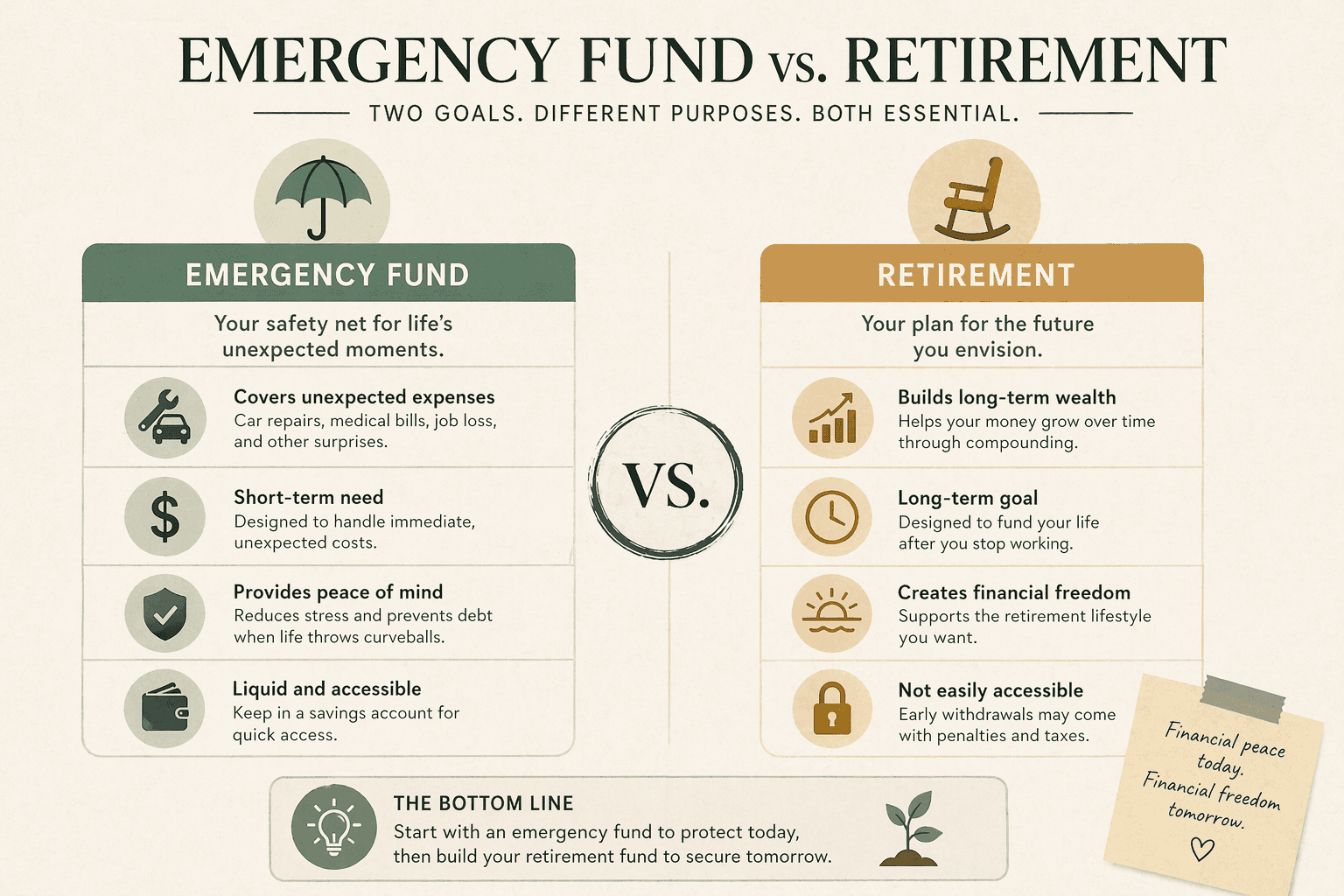
An emergency fund acts as your financial safety net. Most professionals recommend saving three to six months of essential living expenses in a liquid, easily accessible account such as a high-yield savings account or money market fund.
If you have a stable income, three months may be enough
If you’re self-employed or commission-based, aim closer to six months
Why This Matters
Prevents reliance on high-interest credit cards
Reduces financial stress and uncertainty
Protects your long-term investments from being tapped early
Think of your emergency fund as the foundation of your financial house. Without it, everything else becomes unstable.
Step 2: Start Retirement Contributions Early
Once you’ve built a basic emergency cushion, it’s time to start investing for retirement as soon as possible.
The biggest advantage you have is time and compounding.
Every year you delay contributing is a year of potential growth lost. Even small, consistent contributions can grow significantly over time.
For self-employed individuals, tools like a Solo 401(k) provide powerful advantages:
High contribution limits (up to $70,000+, depending on eligibility)
Ability to reduce taxable income
Flexibility to choose between Traditional (pre-tax) or Roth (after-tax) contributions
If you have access to any type of employer match, always contribute enough to take full advantage. That is essentially free money.
Step 3: Balance Both Goals
One of the biggest misconceptions is that you must fully complete one goal before starting the other.
In reality, the most effective strategy is to do both at the same time once you have a small emergency cushion in place.
After saving one to two months of expenses, consider a split approach:
Continue building your emergency fund
Begin contributing to retirement accounts simultaneously
A simple framework many people follow is the 70/15/15 rule:
70% of income toward needs
15% toward wants
15% toward savings and investments
That 15% can be divided between your emergency fund and retirement contributions, depending on your current situation.
This approach allows you to stay protected today while still building wealth for tomorrow.
Step 4: Adjust Over Time
Your financial situation will change over time, and your strategy should evolve with it.
As your emergency fund reaches your target:
Shift more toward retirement contributions
Take advantage of tax-advantaged accounts
Increase contributions as income grows
For those using a Solo 401(k), keep in mind:
Once your plan exceeds $250,000, you will need to file Form 5500-EZ annually
Staying compliant ensures you maintain all tax advantages
The goal is to gradually move from protection mode to growth mode.
Key Takeaways
Build a basic emergency fund first to create stability
Start investing for retirement as early as possible
Don’t wait to finish one goal before starting the other
Adjust your strategy as your income and savings grow
Conclusion
You don’t have to choose between protecting yourself today and building your future.
With the right approach, you can do both.
At Survival401k, the goal is to help business owners and self-employed individuals create flexible, tax-efficient retirement strategies that actually work with how you earn and invest.
This content is for informational and educational purposes only and should not be considered tax, legal, or financial advice.
For many first responders, real estate professionals, small business owners, and self-employed individuals, one of the biggest financial questions is:
Should you build an emergency fund first, or start investing for retirement?
When income fluctuates month to month, this decision becomes even more important. The good news is you don’t have to choose one at the expense of the other. With the right strategy, you can build short-term security while still making progress toward long-term wealth.
Step 1: Secure an Emergency Fund First
Life happens. Unexpected expenses like car repairs, medical bills, or sudden income changes can disrupt even the most disciplined financial plan.
That’s why an emergency fund should be your priority.
An emergency fund acts as your financial safety net. Most professionals recommend saving three to six months of essential living expenses in a liquid, easily accessible account such as a high-yield savings account or money market fund.
If you have a stable income, three months may be enough
If you’re self-employed or commission-based, aim closer to six months
Why This Matters
Prevents reliance on high-interest credit cards
Reduces financial stress and uncertainty
Protects your long-term investments from being tapped early
Think of your emergency fund as the foundation of your financial house. Without it, everything else becomes unstable.
Step 2: Start Retirement Contributions Early
Once you’ve built a basic emergency cushion, it’s time to start investing for retirement as soon as possible.
The biggest advantage you have is time and compounding.
Every year you delay contributing is a year of potential growth lost. Even small, consistent contributions can grow significantly over time.
For self-employed individuals, tools like a Solo 401(k) provide powerful advantages:
High contribution limits (up to $70,000+, depending on eligibility)
Ability to reduce taxable income
Flexibility to choose between Traditional (pre-tax) or Roth (after-tax) contributions
If you have access to any type of employer match, always contribute enough to take full advantage. That is essentially free money.
Step 3: Balance Both Goals
One of the biggest misconceptions is that you must fully complete one goal before starting the other.
In reality, the most effective strategy is to do both at the same time once you have a small emergency cushion in place.
After saving one to two months of expenses, consider a split approach:
Continue building your emergency fund
Begin contributing to retirement accounts simultaneously
A simple framework many people follow is the 70/15/15 rule:
70% of income toward needs
15% toward wants
15% toward savings and investments
That 15% can be divided between your emergency fund and retirement contributions, depending on your current situation.
This approach allows you to stay protected today while still building wealth for tomorrow.
Step 4: Adjust Over Time
Your financial situation will change over time, and your strategy should evolve with it.
As your emergency fund reaches your target:
Shift more toward retirement contributions
Take advantage of tax-advantaged accounts
Increase contributions as income grows
For those using a Solo 401(k), keep in mind:
Once your plan exceeds $250,000, you will need to file Form 5500-EZ annually
Staying compliant ensures you maintain all tax advantages
The goal is to gradually move from protection mode to growth mode.
Key Takeaways
Build a basic emergency fund first to create stability
Start investing for retirement as early as possible
Don’t wait to finish one goal before starting the other
Adjust your strategy as your income and savings grow
Conclusion
You don’t have to choose between protecting yourself today and building your future.
With the right approach, you can do both.
At Survival401k, the goal is to help business owners and self-employed individuals create flexible, tax-efficient retirement strategies that actually work with how you earn and invest.
This content is for informational and educational purposes only and should not be considered tax, legal, or financial advice.